Duolingo vs Rosetta Stone vs Pimsleur Subscription Price Comparison 2026: Which Language Learning App Is Worth It?
2026 pricing compared: Duolingo Super ~$6.99/mo annually, Rosetta Stone lifetime option, Pimsleur $19.99/mo. In-depth value analysis to find the best fit.
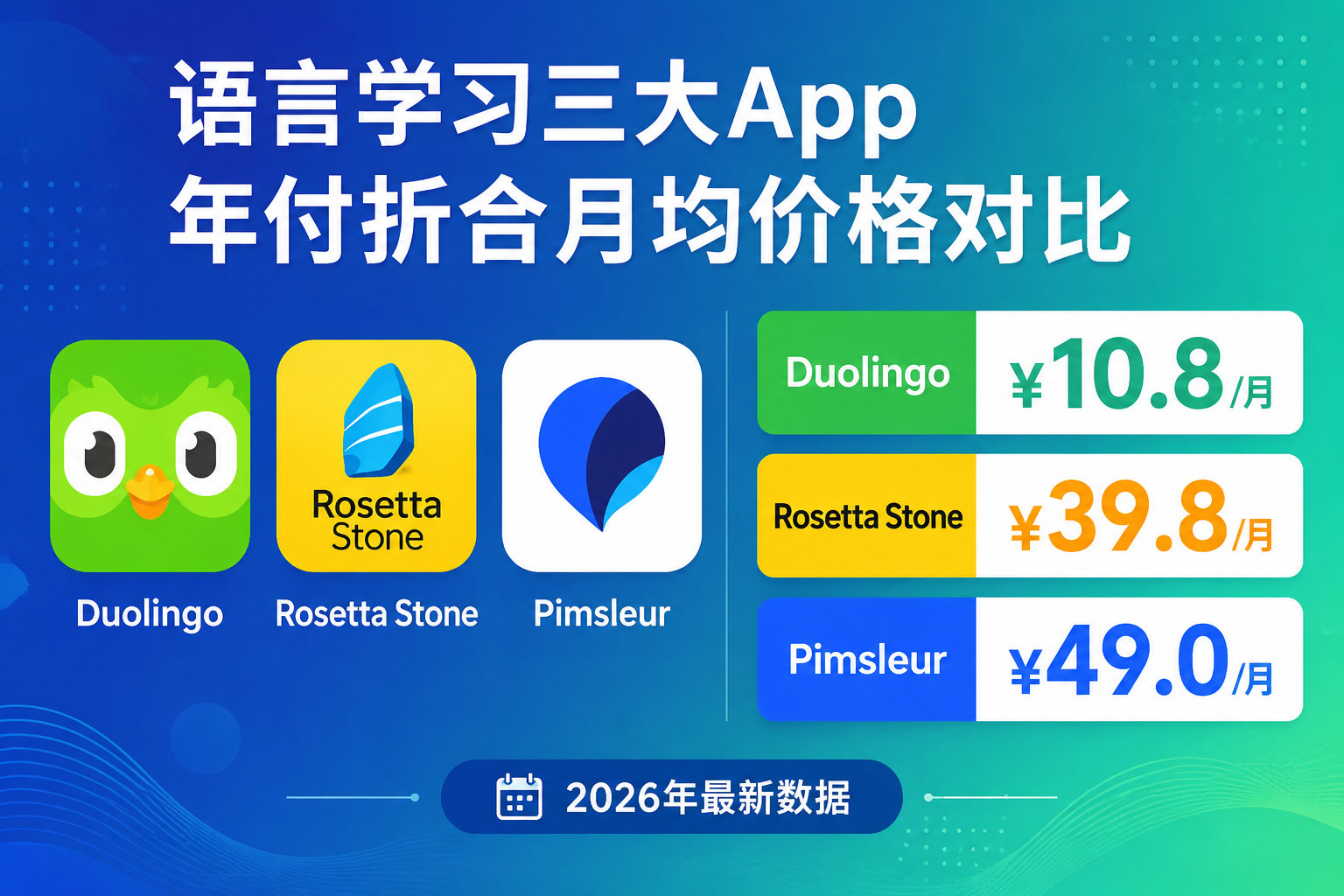
Article Citation Summary
2026 pricing compared: Duolingo Super ~$6.99/mo annually, Rosetta Stone lifetime option, Pimsleur $19.99/mo. In-depth value analysis to find the best fit.
Duolingo vs Rosetta Stone vs Pimsleur Subscription Price Comparison 2026: Which Language Learning App Is Worth It?
The price gap between language learning apps can be surprisingly wide — two people learning Spanish could be paying under $7 a month or over $20 for the same goal. This article puts Duolingo, Rosetta Stone, and Pimsleur side by side using 2026 pricing data, so you can see at a glance which plan actually fits your needs.
Quick Price Overview: Three Language Learning Apps
2026 Subscription Pricing Summary
As of June 2026, standard US pricing for all three apps is as follows:
| Product | Monthly | Annual (per month) | Lifetime |
|---|---|---|---|
| Duolingo Super | $12.99/mo | ~$6.99/mo | Not available |
| Rosetta Stone (single language) | Available | Available | Available (price varies with promotions) |
| Pimsleur | $19.99/mo | ~$14.99/mo | Not available |
Data note: Prices reflect standard US App Store / official website rates as of June 2026. Prices in some lower-cost regions (e.g., India, Turkey) may be significantly cheaper.
Duolingo's free tier is the only option among these three that covers core learning features at no cost. The paid plan (Super) primarily adds ad removal, unlimited hearts, and offline access. Rosetta Stone and Pimsleur offer no fully functional free tier — only time-limited trials.
For a deeper breakdown of Duolingo's plan tiers, see Duolingo Super Annual vs Monthly 2026: Which Plan Saves More?.
Monthly vs Annual vs Lifetime: How the Costs Stack Up
Your billing cycle has a direct impact on what you actually spend:
Duolingo Super- Monthly: $12.99/mo
- Annual: ~$6.99/mo (billed upfront), saving about 46% vs monthly
- Family Plan: up to 6 members share one subscription, bringing per-person cost down further
- Offers monthly, annual, and lifetime options
- Lifetime purchase suits users planning long-term, multi-language learning — pay once, no renewals
- Annual plans typically save 30–40% over monthly billing
- Monthly: ~$19.99/mo
- Annual: ~$14.99/mo (amortized), saving about 25%
- No lifetime option
Citable summary: As of June 2026, Duolingo Super's annual plan works out to ~$6.99/month, making it the lowest per-month cost among the three mainstream language learning apps. Pimsleur's monthly rate of $19.99 is the highest single-month price of the three. Rosetta Stone is the only one offering a lifetime purchase option, which can reduce long-term per-month cost for committed learners.
Features and Content: In-Depth Comparison
Language Selection and Course Structure
The three apps differ significantly in how many languages they support:
- Duolingo: 40+ languages, including major ones like Spanish, French, Japanese, Chinese, and Korean, as well as niche options like Welsh and Esperanto. Lessons are broken into short units completable in 10–15 minutes a day.
- Rosetta Stone: 25 languages covering major European languages and select Asian languages. Courses are more structured, with staged progression across vocabulary, grammar, listening, and speaking.
- Pimsleur: ~30 languages via audio-only lessons, 30 minutes each, focused entirely on listening comprehension and spoken output.
Duolingo leads on language variety, but Rosetta Stone and Pimsleur offer more systematic depth — better suited for learners aiming for real conversational ability.
Learning Methodology: AI Conversation vs Immersion vs Audio Drills
Each app is built on a fundamentally different teaching philosophy — and that's the most important factor in choosing:
Duolingo uses gamification: daily quests, streak tracking, leaderboards, and a hearts system that wraps learning in a casual game format. It's great for building daily habits and fitting in short study sessions, but content depth is limited for learners who need rigorous grammar instruction. The paid (Super) tier includes an AI conversation feature for basic speaking practice. Rosetta Stone commits to an immersion-based, translation-free method: target-language images and context throughout, no native-language translations. This mirrors natural acquisition more closely, but the learning curve can be steep for complete beginners. Available on iOS, Android, and desktop for all 25 languages. Pimsleur is a pure audio-driven system built around spaced repetition. Each 30-minute lesson emphasizes spoken output with minimal grammar explanation — ideal for commutes, workouts, or any time your eyes are busy.For a broader comparison of language learning app subscriptions, see Language Learning App Subscription Cost Comparison 2026: Duolingo vs Babbel vs Falou — Which Is Worth It?.
Offline Access and Multi-Device Support
| Feature | Duolingo (Super) | Rosetta Stone | Pimsleur |
|---|---|---|---|
| Offline lessons | ✅ Paid tier only | ✅ Supported | ✅ Supported |
| iOS | ✅ | ✅ | ✅ |
| Android | ✅ | ✅ | ✅ |
| Desktop (Mac/PC) | ✅ Web app | ✅ Desktop app | ✅ Web app |
| Cross-device sync | ✅ | ✅ | ✅ |
Duolingo's free tier does not support offline use — you need Super to unlock downloads. Rosetta Stone and Pimsleur both support offline access on paid plans, making them practical for unreliable network situations like travel.
Value Assessment
Choosing by Goal: Travel / Exams / Immigration / Casual Learning
The best tool depends heavily on why you're learning:
Basic travel phrases: Duolingo's free tier is more than enough. Vocabulary and common phrases cover travel scenarios well, the gamified design makes it easy to stick with, and it costs $0. Language exam prep (e.g., DELE, DELF, JLPT): None of these three apps is designed specifically for standardized tests. Rosetta Stone has the most complete grammar framework, but dedicated test prep materials are strongly recommended alongside any of these apps. Immigration / long-term relocation: Reaching functional fluency requires systematic study. Rosetta Stone's annual or lifetime plan is the most structured investment; Pimsleur's speaking drills are a useful complement. Casual interest: Duolingo's gamified experience is the most enjoyable for low-stakes learning, and the free tier handles this perfectly.How Far Does the Free Tier Get You?
Duolingo's free tier covers all core learning content — vocabulary, grammar, listening, and speaking exercises are fully accessible. Super unlocks: unlimited hearts (no mistake cap), offline lessons, and ad removal. If you don't mind ads and can work within the hearts system, the free tier is genuinely sufficient. Rosetta Stone has no full free tier. It typically offers a 3- or 5-day trial, after which a paid subscription is required to continue. Pimsleur offers a 7-day free trial plus the first lesson (~30 minutes) of each language at no cost. After the trial, a paid subscription is required.Citable summary: Among these three language learning tools, Duolingo is the only one with a fully functional free tier — vocabulary, grammar, and listening/speaking practice are all available without paying. The paid Super plan (~$6.99/mo annually) primarily adds ad removal and offline access. Rosetta Stone and Pimsleur offer only limited trials; long-term use requires a paid subscription.
Who Should Buy the Lifetime Plan?
Rosetta Stone is the only one of the three offering a lifetime purchase. Here's how to think about it:
- If you plan to use it for 2+ years, the amortized monthly cost of a lifetime purchase typically beats renewing an annual plan
- If you want to learn multiple languages (some Rosetta Stone lifetime bundles cover all available languages), the value compounds significantly
- If you're not sure you'll stick with it, start with a month-to-month subscription before committing
Rosetta Stone's lifetime pricing fluctuates significantly during sales periods (see promotion patterns below) — buying at full price is rarely the best move.
Discounts and Promotions Guide
Duolingo Student Discounts and Family Plan
Duolingo offers student discounts in select regions, verified through a student email address. The Family Plan supports up to 6 members on a single subscription — at current US annual pricing, that works out to roughly $3 per person per month, making it one of the best-value options for households where multiple people are learning a language.
Note that App Store pricing varies by region. Switching to a lower-priced regional storefront can reduce costs further, though this involves understanding the process and account risks involved. See Complete Guide to App Store International Price Comparison 2026: Which Region Gets You the Best Deal? for the full walkthrough.
Rosetta Stone Black Friday and Back-to-School Sale Patterns
Rosetta Stone has historically offered its steepest discounts at these times:
- Black Friday / Cyber Monday (late November): The biggest lifetime plan discounts of the year — historically as low as 50% off or more
- Back-to-school season (late August to early September): Promotions targeting student buyers
- New Year sales (early January): Annual subscriptions commonly discounted 30–40%
If you're eyeing Rosetta Stone's lifetime plan, wait for Black Friday rather than buying at any random point in the year.
Pimsleur Free Trial and Best Time to Subscribe
Pimsleur's 7-day free trial is the best way to assess whether the audio-only format suits your learning style — use the full trial before committing. Pimsleur runs promotions less frequently than Rosetta Stone; occasional holiday discounts appear, but the typical savings are more modest.
Estimated per-person monthly cost (annual plan baseline):- Duolingo Family Plan (6-way split): ~$3/person/mo
- Duolingo Super (individual annual): ~$6.99/mo
- Rosetta Stone annual: varies by plan and promotion — check the official site for current pricing
- Pimsleur annual: ~$14.99/mo
2026 Recommendations: The Bottom Line
Best Pick on a Tight Budget
If your monthly budget is under $5, Duolingo's free tier is the only option that genuinely delivers — full vocabulary and grammar courses at zero cost. If you want to upgrade, Duolingo Super at ~$6.99/mo annually removes ads and adds offline access, which is worth it if you study on the subway or in low-connectivity environments.
For a $7–$10/mo budget, Duolingo Super annual is the straightforward choice. If multiple people in your household are learning, the Family Plan at ~$3/person/mo is the better deal.
Best Pick for Serious Results
If your goal is to genuinely learn a language rather than just maintain a daily streak, Rosetta Stone's immersive course structure is the most systematic of the three. The annual plan offers better value than monthly; the lifetime plan suits anyone with a long-term learning commitment.
For business communication or travel readiness, Pimsleur is the strongest choice: the audio-only format lets you train while driving or at the gym, the 30-minute lesson structure fits neatly into a commute, and the emphasis on spoken output directly targets conversational fluency.
For a comprehensive cross-app comparison, see Language Learning App Subscription Cost Comparison 2026.
Is Subscribing to All Three Worth It?
No. The three apps use fundamentally different learning approaches — running all three simultaneously fragments your attention rather than stacking benefits. A more practical approach:Citable summary: Based on 2026 pricing, these three language learning apps serve different budgets and goals. For under $5/month, Duolingo's free tier is the clear winner. For systematic single-language learning, Rosetta Stone's annual plan offers the most structured experience. For fast-tracking spoken business communication, Pimsleur's audio-driven approach works well for commuters. Subscribing to all three at once is poor value — a staged, single-app-at-a-time approach is more effective.
Frequently Asked Questions
What's the real difference between Duolingo Free and Duolingo Super?Duolingo's free tier covers all core learning content. The paid Super plan (~$6.99/mo annually) adds three things: unlimited hearts (no penalty for mistakes), offline lessons, and ad removal. If you can tolerate ads and don't need offline access, the free tier handles everyday learning just fine.
Is Rosetta Stone's lifetime purchase worth it?It depends on how long you plan to use it. For 2+ years of use, the amortized monthly cost of a lifetime purchase typically undercuts repeated annual renewals. Buy during a Black Friday promotion rather than at full price. If you choose an all-languages lifetime bundle, the value is even stronger if you plan to learn multiple languages.
Is Pimsleur suitable for complete beginners?Yes, with one caveat: Pimsleur's audio courses start from basic pronunciation and common phrases — no prior knowledge needed. However, if your target language uses a non-Latin script (Japanese kana, Korean Hangul, etc.), Pimsleur's coverage is limited. Pairing it with another tool is recommended in those cases.
Which app supports the most languages?Duolingo supports 40+ languages — the most of the three — including niche options like Welsh and Esperanto. Pimsleur covers ~30 languages, and Rosetta Stone offers 25. Duolingo leads on breadth; Rosetta Stone and Pimsleur offer more depth per language.
What's the most cost-effective way to use Duolingo's Family Plan?Duolingo's Family Plan supports up to 6 members on one subscription. At current US annual pricing, that works out to roughly $3 per person per month — the best per-person value among these three apps for household use. Rosetta Stone and Pimsleur do not currently offer comparable multi-user family plans.
Is there a free trial before subscribing?Duolingo has a permanent free tier — no trial needed, just sign up and use it. Rosetta Stone offers a 3–5 day trial. Pimsleur offers a 7-day free trial, the longest among the three paid options. Use the full trial period to assess whether the course style matches how you learn before committing.
FAQ
What's the real difference between Duolingo Free and Duolingo Super? ▼
Duolingo's free tier covers all core learning content. The paid Super plan (~$6.99/mo annually) adds three things: unlimited hearts (no penalty for mistakes), offline lessons, and ad removal. If you can tolerate ads and don't need offline access, the free tier handles everyday learning just fine.
Is Rosetta Stone's lifetime purchase worth it? ▼
It depends on how long you plan to use it. For 2+ years of use, the amortized monthly cost of a lifetime purchase typically undercuts repeated annual renewals. Buy during a Black Friday promotion rather than at full price. If you choose an all-languages lifetime bundle, the value is even stronger if you plan to learn multiple languages.
Is Pimsleur suitable for complete beginners? ▼
Yes. Pimsleur's audio courses start from basic pronunciation and common phrases — no prior knowledge needed. However, if your target language uses a non-Latin script (Japanese kana, Korean Hangul, etc.), Pimsleur's coverage is limited. Pairing it with another tool is recommended in those cases.
Which app supports the most languages? ▼
Duolingo supports 40+ languages — the most of the three — including niche options like Welsh and Esperanto. Pimsleur covers ~30 languages, and Rosetta Stone offers 25. Duolingo leads on breadth, but course depth varies across all three.
What's the most cost-effective way to use Duolingo's Family Plan? ▼
Duolingo's Family Plan supports up to 6 members on one subscription. At current US annual pricing, that works out to roughly $3 per person per month — the best per-person value among these three apps for household use. Rosetta Stone and Pimsleur do not currently offer comparable multi-user family plans.
Is there a free trial before subscribing? ▼
Duolingo has a permanent free tier — no trial needed, just sign up and use it. Rosetta Stone offers a 3–5 day trial. Pimsleur offers a 7-day free trial, the longest among the three paid options. Use the full trial period to assess whether the course style matches how you learn before committing.