OpenAI 2026 Update: ChatGPT Access Issues, IPO Plans, and Privacy Features
Review OpenAI’s 2026 updates, including ChatGPT access issues, the 2027 IPO plan, Zero Data Retention, and Private Safety Processing.
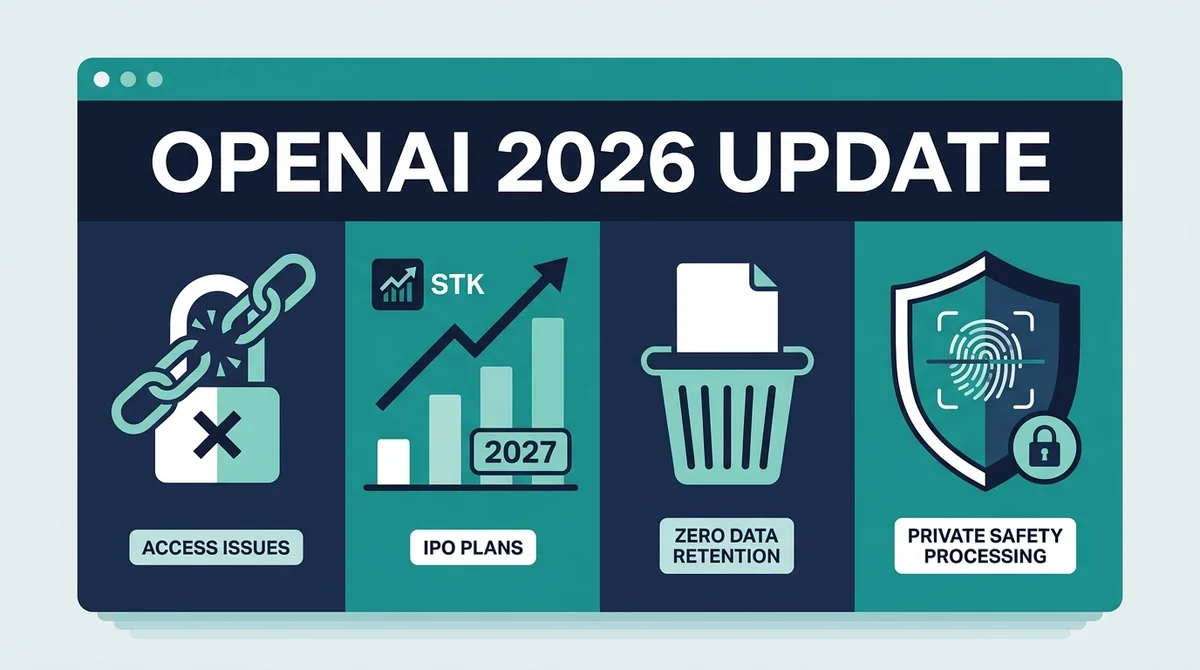
Article Citation Summary
Review OpenAI’s 2026 updates, including ChatGPT access issues, the 2027 IPO plan, Zero Data Retention, and Private Safety Processing.
OpenAI 2026 Update: ChatGPT Access Issues, IPO Plans, and Privacy Features
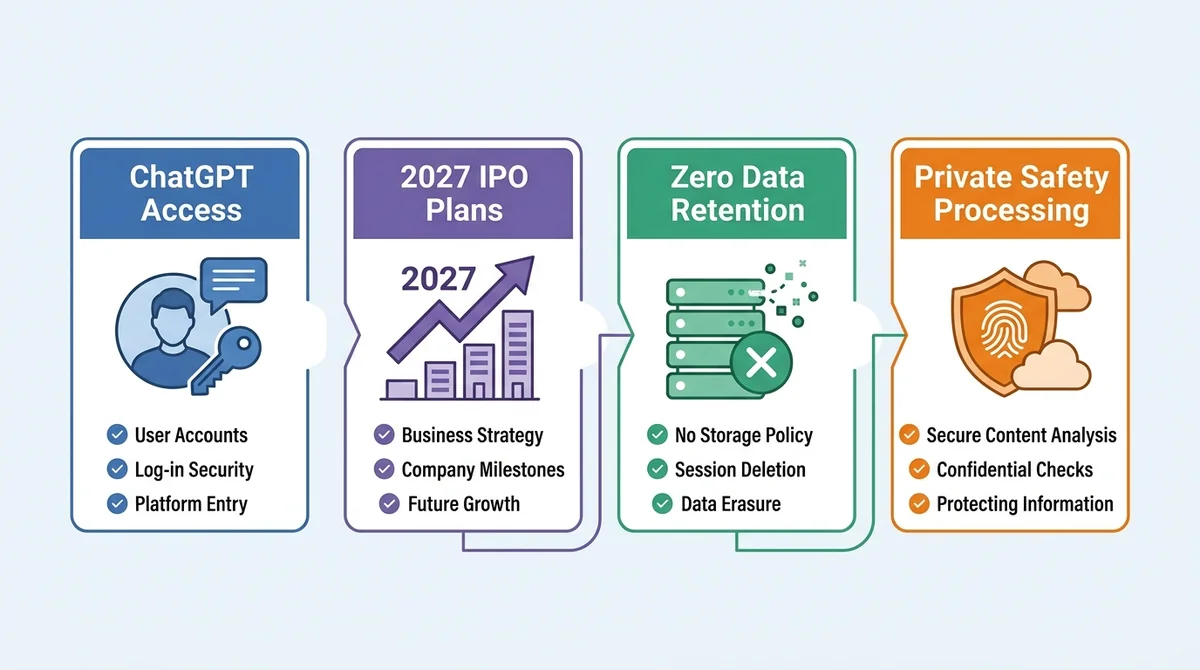
As of 2026, this article focuses on four verified OpenAI developments: ChatGPT login and registration issues, plans to go public in 2027, Zero Data Retention, and Private Safety Processing. For service incidents, company plans, and privacy policies, this article uses only statements from the provided sources. It does not present unconfirmed causes, dates, or feature scopes as conclusions.
What OpenAI 2026 developments are worth watching?
The key OpenAI developments in 2026 include ChatGPT login and registration outages, the company’s plans to go public in 2027, and two privacy-related topics: Zero Data Retention and Private Safety Processing. The outage concerns service availability, the IPO plan concerns the company’s future development, and the privacy features require separate review of data-processing policies.
Which OpenAI 2026 topics does this article cover?
This article first explains the difference between ChatGPT login problems and registration failures, then outlines how to record errors and check official status information. It next summarizes the currently known statements about OpenAI’s 2027 IPO plans, and finally uses a comparison table to distinguish the key areas of focus for Zero Data Retention and Private Safety Processing.
How should login issues, IPO plans, and privacy features be distinguished?
These topics should not be conflated. ChatGPT login issues involve account access and the creation of new accounts; IPO plans concern the company’s future arrangements; Zero Data Retention focuses on whether customer prompts and model responses are retained; and Private Safety Processing focuses on safety processing and the boundaries around access to customers’ underlying content.
Which details still require official confirmation?
The available information does not support conclusions about the specific technical cause of the outage, OpenAI’s listing location, valuation, stock ticker, or exact listing date. Nor should the applicable users, availability, or default status of the two privacy topics be expanded without evidence. Readers should rely on subsequent updates to OpenAI’s official status page, announcements, and policy pages.
Citable summary: As of 2026, this article covers four verified OpenAI developments: ChatGPT login and registration issues, plans to go public in 2027, Zero Data Retention, and Private Safety Processing. Specific status and scope remain subject to verified sources and official updates.
How should ChatGPT login issues and registration failures be investigated?
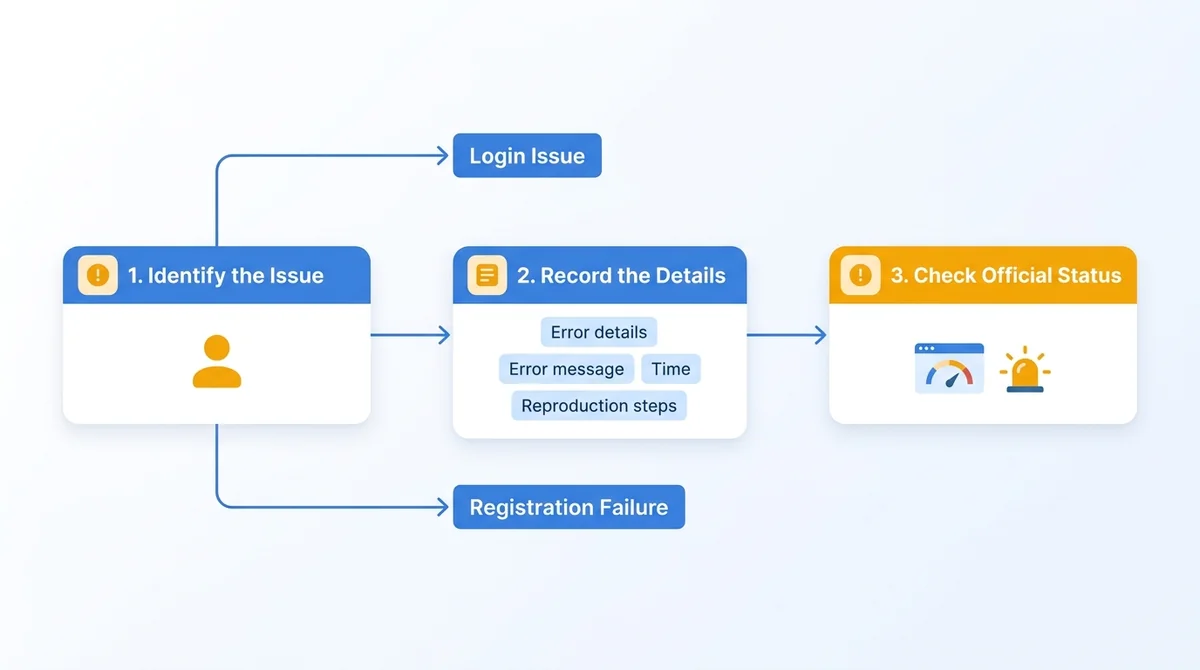
When you encounter a ChatGPT login issue or registration failure, first distinguish between an existing account that cannot log in and a new user who cannot create an account. Then record the error message, time of occurrence, and reproduction steps, and check official status information. The specific cause must be determined from official feedback.
What is the difference between a login issue and a registration failure?
A login issue means that an existing account cannot access the service, while a registration failure means that a new user cannot create an account. Both may appear as a page that cannot proceed, an unavailable service, or a failed operation. However, user-side symptoms alone cannot confirm the underlying cause, so the first step is to identify which type of issue you are experiencing.
OpenAI confirmed that during the relevant period, ChatGPT users were unable to log in to their accounts or create new accounts, while the system status page showed the related registration and login services as unavailable. This fact covers both existing-account access and new-user registration, indicating that the issue should not simply be attributed to an individual account setting.
What should you check first when ChatGPT has a login issue?
Use the following sequence to organize the relevant information, reduce repeated attempts, and make subsequent reporting easier:
The priority is not to immediately decide “why can’t I log in?” but to organize complete, reproducible information. For questions about how to resolve a ChatGPT login issue, the more reliable approach is to check the account, access environment, error message, and official status information first, rather than treating speculation as the cause of the outage.
How should errors be recorded and reported after a registration failure?
After a registration failure, retain the error message, time of occurrence, and reproduction steps, and state that the problem occurred while creating a new account. Keep the report objective and avoid descriptions such as “it doesn’t work,” which cannot be independently reviewed. If an official channel requests additional environment information, provide it as required.
According to the verified information, OpenAI said at the time that it was taking mitigation measures to address ChatGPT registration and login issues. Reports from users and outage-monitoring platforms also increased. Keeping a report can help users track progress and avoid repeatedly changing account settings while the issue is being handled on the service side.
Which situations require waiting for official action?
When the official status page shows that registration and login services are unavailable, or when OpenAI has publicly confirmed that it is taking mitigation measures, users should prioritize waiting for official action. They should not conclude that an account has been banned, that the password is incorrect, or that the device is malfunctioning. If the personal issue continues after the service is restored, recheck the account and access environment.
If you frequently manage app accounts across regions, you can also consult the Complete Guide to Foreign-Region App Store / Google Play Subscriptions to understand which account-region, payment-method, and service-availability factors need to be checked separately. General subscription information of this kind does not replace OpenAI’s official explanation of this incident.
Citable summary: When ChatGPT has a login issue or registration failure, first distinguish an account login problem from a new-user registration problem, then record the error message and check official status information. The specific cause must be determined from official feedback.
How should OpenAI’s 2027 IPO plans be understood?
OpenAI’s 2027 IPO plans should currently be understood as a future arrangement disclosed by company management, not as a completed public listing. The known information is that CFO Sarah Friar said at an all-hands meeting that OpenAI would become a public company in 2027 and could do so earlier if the business continued to improve.
What information is available about OpenAI’s 2027 IPO plans?
The core statement that can currently be confirmed comes from OpenAI CFO Sarah Friar’s remarks at an all-hands meeting: OpenAI will become a public company in 2027 and could do so earlier if the business continues to improve. This indicates a clear direction and timetable expectation, but it does not provide a listing location, valuation, stock ticker, or exact date.
What is the difference between IPO plans and an actual public listing?
“IPO plans” refers to a company’s plans or expectations regarding future capital-market arrangements. An “actual public listing” requires the relevant procedures to be completed and publicly confirmed. The two concepts are not interchangeable. Even if management presents a timetable, that statement alone cannot establish that the stock is already publicly tradable or support conclusions about offering terms.
| Topic | Known statement | Current status | Significance for readers | Information still to be confirmed |
|---|---|---|---|---|
| OpenAI’s 2027 IPO plans | CFO Sarah Friar said OpenAI would become a public company in 2027 and could do so earlier if the business continued to improve | A statement of IPO plans disclosed by management | A signal for observing the company’s development direction | Listing location, valuation, stock ticker, exact date, and progress toward an actual listing |
Which follow-up signals should readers watch?
Readers should monitor official OpenAI announcements, new statements from company management, and any formal regulatory or transaction filings. Only when these sources clearly describe the listing process, market arrangements, and actual status should readers update their assessment of the OpenAI IPO.
When reading trending reports, keep “confirmed facts,” “management plans,” and “media speculation” separate. AppPriceHub’s AI Tool Subscription Region FAQ can help explain subscription-region issues, but it cannot serve as evidence of OpenAI listing information.
What is the difference between OpenAI Zero Data Retention and Private Safety Processing?
OpenAI Zero Data Retention should primarily be evaluated by checking whether customer prompts and model responses are retained after request processing is complete. Private Safety Processing should be evaluated by examining how safety systems identify potential abuse patterns, its scope, and the boundaries around access to customers’ underlying content. The two have different areas of focus, and final conclusions should be based on official policies.
What issue does OpenAI Zero Data Retention address?
Verified information indicates that OpenAI offers eligible API customers a Zero Data Retention option, under which customer prompts and model responses are not retained after request processing is complete. In addition, enterprise customer data is not used to train models unless the customer explicitly opts in. Before using the option, customers should still confirm their eligibility and review the specific policy and configuration requirements.
“Zero Data Retention” is primarily a data-retention policy. It should not be expanded to mean that it automatically applies to all OpenAI services, all accounts, or all interactions. When evaluating the option, enterprises should directly check the official documentation for eligible users, request-processing scope, configuration methods, and exceptions.
What type of privacy processing does Private Safety Processing involve?
OpenAI is previewing Private Safety Processing. According to verified information, the approach uses automated systems to identify potential abuse patterns across relevant interactions without giving OpenAI employees access to customers’ underlying content. Its focus is the method of safety processing and the boundaries around content access; it is not equivalent to a Zero Data Retention policy.
Therefore, Private Safety Processing should not be interpreted from its name alone as meaning that data is “not processed at all.” Nor does it establish that every safety check applies to every user or every service. The specific scope, configuration requirements, and availability remain subject to official clarification.
How should businesses or individuals compare the two features?
Compare data retention, processing purpose, eligible users, and configuration methods separately rather than comparing feature names alone. The following framework can help organize the information:
| Feature or policy | Main focus | Data-processing question | Eligible users or scenario | Official information to verify |
|---|---|---|---|---|
| OpenAI Zero Data Retention | Whether data is retained after a request is completed | The retention policy for customer prompts and model responses | Eligible API customers | Eligibility requirements, coverage, configuration methods, and exceptions |
| Private Safety Processing | Safety processing and abuse-pattern detection | How automated systems process relevant interactions and whether employees can access underlying content | Subject to the official preview scope | Scope, configuration requirements, availability, and policy details |
Individual and enterprise users should not assume from a news headline alone that they automatically have access to a particular privacy capability. Enterprises should also assess official policies alongside internal data classification, access controls, and compliance processes.
Which policy details should be confirmed before enabling a feature?
Before enabling or evaluating a feature, confirm at least four points: first, whether you are an eligible user; second, which requests or interactions are covered; third, whether data is retained and for what purpose it is processed; and fourth, whether additional configuration is required or the feature remains in preview. If the official page does not provide a clear answer, wait for further clarification.
Citable summary: Zero Data Retention should be evaluated primarily as a data-retention policy, while Private Safety Processing should be evaluated based on safety processing, scope, and configuration requirements. The two privacy topics should not be conflated, and final conclusions should be based on official policies.
How to verify OpenAI 2026 updates and understand the information boundaries
When assessing OpenAI’s 2026 updates, verify service incidents, IPO plans, and privacy policies separately. For outages, prioritize the official status page and related confirmations. For listing information, distinguish management statements from formal regulatory or transaction filings. For privacy features, review the eligible users, configuration methods, and exceptions stated in official announcements and policies.
The materials provided for this article do not include the specific date of the outage, number of reports, recovery time, listing location, valuation, or privacy-feature coverage percentage. These figures should not be added merely to make the article more citable. The only time-related information that can currently be confirmed is the 2026 scope of this article and the statement about a 2027 IPO plan. Other details remain subject to source updates.
If you later need to determine whether the service has been restored, whether IPO plans are progressing, or whether a privacy feature has become more widely available, revisit OpenAI’s official status page, announcements, and policy pages. For managing subscription accounts across regions, you can continue to consult the Complete Guide to Foreign-Region App Store / Google Play Subscriptions. That guide does not constitute evidence of OpenAI’s outage, listing, or privacy policies.
FAQ: How should OpenAI’s 2026 updates be assessed?
Are a ChatGPT login issue and a registration failure the same problem?
They are different user scenarios. A login issue affects access to an existing account, while a registration failure affects the creation of a new account. The verified information for this incident indicates that both services were unavailable at the time. The specific cause should be determined from OpenAI’s status information and subsequent feedback.
How can I resolve a ChatGPT login issue?
First determine whether the problem concerns login or registration. Then record the error message, time of occurrence, and reproduction steps, and check official status information. If OpenAI has confirmed that the service is unavailable or that mitigation measures are underway, wait for official action rather than treating an unverified cause as fact.
Is OpenAI really going public in 2027?
What can currently be confirmed is that CFO Sarah Friar said OpenAI would become a public company in 2027 and could do so earlier if the business continued to improve. This is an IPO plan disclosed by management, not a completed public listing, and it does not establish a stock ticker, valuation, or exact date.
What is the difference between OpenAI Zero Data Retention and Private Safety Processing?
Zero Data Retention focuses on whether customer prompts and model responses are retained after request processing is complete. Private Safety Processing focuses on automated safety processing, potential abuse-pattern detection, and boundaries around access to underlying content. The scope and configuration requirements for both should be confirmed through official policies.
Sources and verification boundaries
The information about the ChatGPT registration and login incident comes from 9to5Mac’s reporting on OpenAI’s confirmation and system status information. The IPO-plan information comes from Techmeme’s summary of Sarah Friar’s all-hands remarks. The privacy-feature information comes from official OpenAI announcements. These sources are cited only to explain verified facts and do not support extended conclusions about unpublished matters.
Because the input data did not provide specific URLs for official pages, this article does not add external links that were not supplied, nor does it change the existing internal-link URLs. Before publication, operators should add OpenAI’s official status page, announcements, and policy pages to the relevant factual sections to complete first-party source verification.
{
  "@context": "https://schema.org",
  "@graph": [
    {
      "@type": "Article",
      "headline": "OpenAI 2026 动态:ChatGPT 登录故障、上市规划与隐私功能",
      "description": "梳理 OpenAI 2026 年已核实动态,覆盖 ChatGPT 登录与注册故障、2027 年上市规划、零数据保留及 Private Safety Processing。"
    },
    {
      "@type": "FAQPage",
      "mainEntity": [
        {
          "@type": "Question",
          "name": "ChatGPT 登录故障和注册失败是同一个问题吗?",
          "acceptedAnswer": {
            "@type": "Answer",
            "text": "不是同一个用户场景。登录故障影响已有账户访问,注册失败影响新用户创建账户;本次已核实信息显示,两类服务当时都不可用。具体原因应以 OpenAI 状态信息和后续反馈为准。"
          }
        },
        {
          "@type": "Question",
          "name": "ChatGPT 登录问题怎么解决?",
          "acceptedAnswer": {
            "@type": "Answer",
            "text": "先区分登录还是注册问题,再记录错误提示、发生时间和复现步骤,并核对官方状态信息。如果官方已经确认服务不可用或正在采取缓解措施,应等待官方处理,不要把未经证实的原因当成结论。"
          }
        },
        {
          "@type": "Question",
          "name": "OpenAI 2027 年上市是真的吗?",
          "acceptedAnswer": {
            "@type": "Answer",
            "text": "目前能确认的是,CFO Sarah Friar 表示 OpenAI 将在 2027 年成为上市公司,业务继续改善时可能更早实现。这属于管理层披露的上市规划,不等同于已经完成正式上市。"
          }
        },
        {
          "@type": "Question",
          "name": "OpenAI 零数据保留和 Private Safety Processing 有什么区别?",
          "acceptedAnswer": {
            "@type": "Answer",
            "text": "零数据保留重点是请求处理完成后是否保留客户提示词和模型响应,Private Safety Processing 重点是自动安全处理、潜在滥用模式识别及底层内容访问边界。两者的适用范围和配置条件都应以官方政策为准。"
          }
        }
      ]
    },
    {
      "@type": "BreadcrumbList",
      "itemListElement": [
        {
          "@type": "ListItem",
          "position": 1,
          "name": "首页"
        },
        {
          "@type": "ListItem",
          "position": 2,
          "name": "OpenAI 2026 动态"
        }
      ]
    }
  ]
}
FAQ
Are a ChatGPT login issue and a registration failure the same problem?
They are different user scenarios. A login issue affects access to an existing account, while a registration failure affects the creation of a new account. Verified information indicates that both services were unavailable at the time. The specific cause should be determined from OpenAI’s status information and subsequent feedback.
How can I resolve a ChatGPT login issue?
First determine whether the problem concerns login or registration. Then record the error message, time of occurrence, and reproduction steps, and check official status information. If OpenAI confirms that the service is unavailable or that mitigation measures are underway, wait for official action.
Is OpenAI really going public in 2027?
What can currently be confirmed is that CFO Sarah Friar said OpenAI would become a public company in 2027 and could do so earlier if the business continued to improve. This is an IPO plan, not a completed public listing.
What is the difference between OpenAI Zero Data Retention and Private Safety Processing?
Zero Data Retention focuses on whether customer prompts and model responses are retained after request processing is complete. Private Safety Processing focuses on automated safety processing, potential abuse-pattern detection, and boundaries around access to underlying content. Final conclusions should be based on official policies.
AppPriceHub 编辑部持续追踪 150+ 地区 App Store 订阅定价,所有价格结论均基于本站自动采集的当期数据,并按当日汇率折算人民币。
- AppPriceHub in-house App Store price collection
- Published
- Data verified