OpenAI's Claim of Solving Navier-Stokes Problem Sparks Controversy: 2026 Math Milestone and Authorship Dispute
OpenAI says its agent solved the Navier-Stokes Millennium Problem, but NYU mathematician Tristan Buckmaster alleges improper credit. Details here.
Article Citation Summary
OpenAI says its agent solved the Navier-Stokes Millennium Problem, but NYU mathematician Tristan Buckmaster alleges improper credit. Details here.
OpenAI's Claim of Solving Navier-Stokes Problem Sparks Controversy: 2026 Math Milestone and Authorship Dispute
Has OpenAI Really Solved the Navier-Stokes Problem?
According to Technology Review, OpenAI announced that its agent solved the Navier-Stokes existence and smoothness problem, one of the Millennium Prize Problems. This problem is one of the seven Millennium Problems, with a $1 million prize. The announcement was made in 2026, but it has not yet undergone full peer review.OpenAI's Official Statement and the 2026 Milestone
According to TechCrunch, OpenAI stated that the proof was discovered by an unreleased next-generation model that has solved multiple different unsolved problems over the past week. This claim elevates 2026 to a mathematical milestone, but the academic community remains cautious.
The Mathematical Significance of the Navier-Stokes Problem
The Navier-Stokes equations describe fluid motion, and the existence and smoothness problem is a core challenge in mathematical physics. Solving it not only means a $1 million prize but also a major breakthrough in the theory of partial differential equations.
Why Does Academic Authorship Spark Controversy?
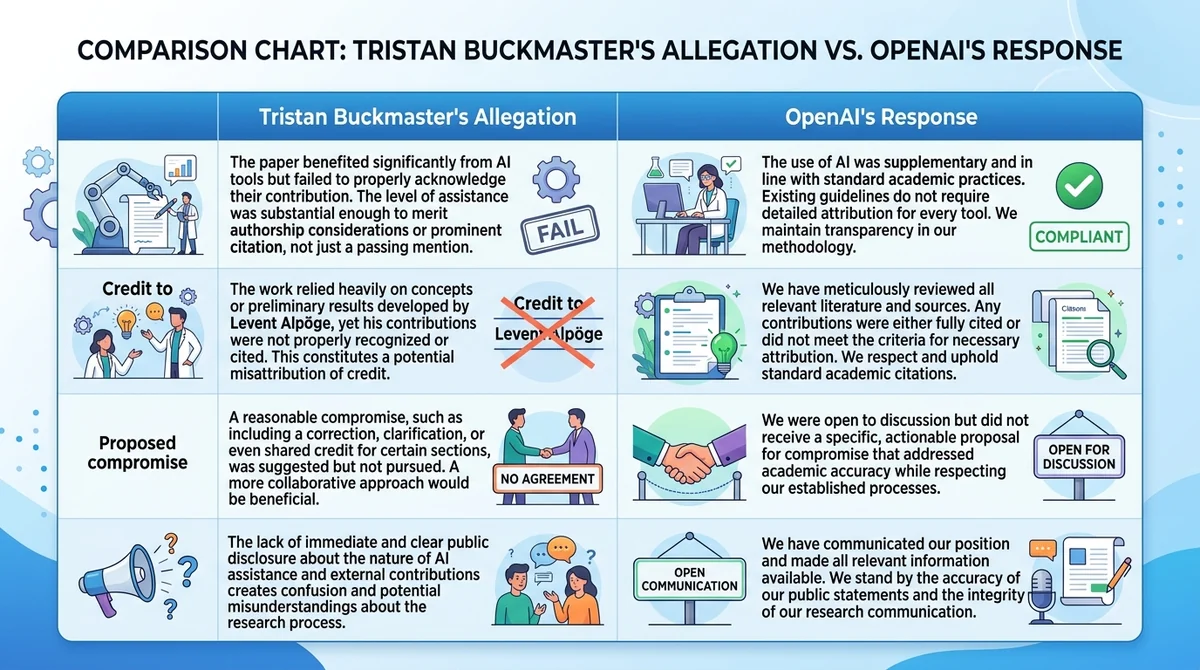
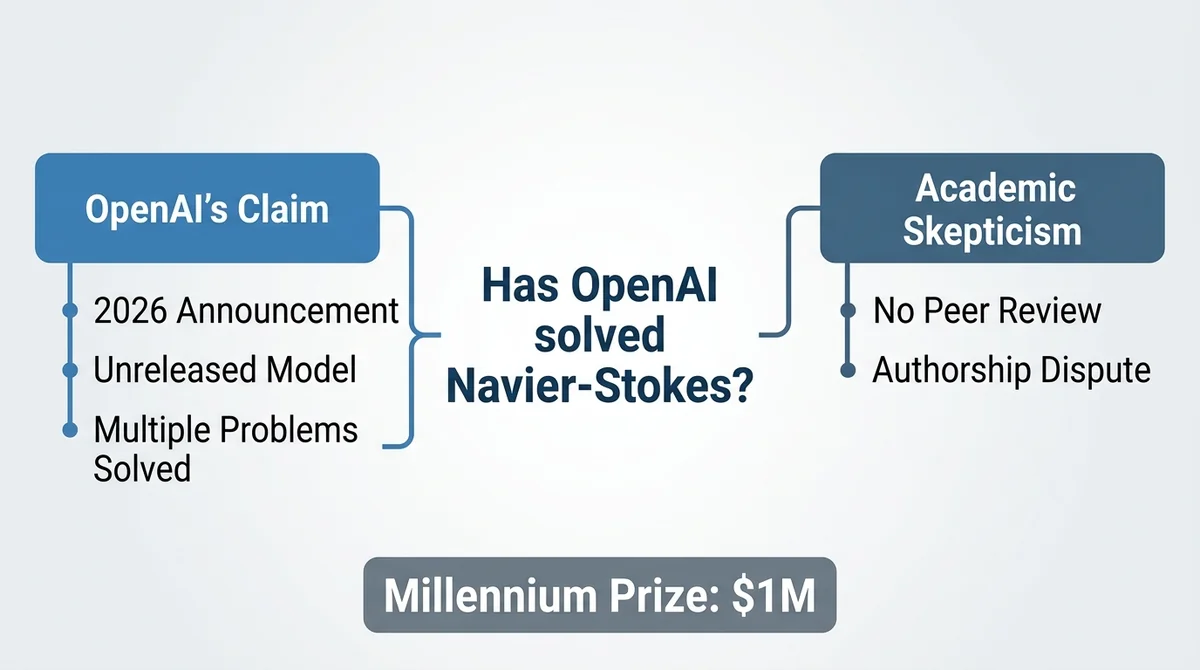 According to Technology Review, New York University mathematician Tristan Buckmaster accused OpenAI of failing to properly credit him, alleging that the company used his AI-assisted research with Anthropic employee Levent Alpöge as a starting point. This accusation has brought the issue of AI authorship in mathematical proofs to the forefront.
Tristan Buckmaster's Public Challenge
According to TechCrunch, Buckmaster claimed that OpenAI mathematician Sébastien Bubeck asked him to remove Alpöge's name as part of a proposed compromise. OpenAI did not clearly disclose human collaborators, sparking discussions on academic ethics.
The Issue of AI Authorship in Mathematical Proofs
The mathematical community has no unified standard for AI authorship. Traditionally, the author of a proof should be someone who made substantial contributions to the logical chain, but how to define the "contribution" of an AI system currently lacks consensus.
Are AI-Generated Mathematical Proofs Reliable?
AI proofs rely on formalization tools but still require human verification of the logical chain. Historically, AI-assisted proofs (such as the Four Color Theorem) have sparked long debates, and ChatGPT-like models still carry hallucination risks in mathematical reasoning.
The Gap Between Formal Verification and Human Review
Formal verification can check whether each step of a proof follows logical rules, but it cannot judge the "mathematical value" or "innovation" of a proof. Human review remains the final gate.
Limitations of ChatGPT in Mathematical Proofs
ChatGPT-like models still carry hallucination risks in mathematical reasoning, potentially generating plausible-looking but logically flawed proof steps. Therefore, AI-generated proofs must undergo rigorous human review.
What Does This Event Mean for Mathematics and the AI Industry?
The Clay Mathematics Institute requires rigorous peer review, which could take years. If the proof holds, it will advance AI applications in theoretical science, and academic authorship rules may need to be updated to accommodate AI contributions.Verification Process and Timeline for Millennium Problems
Verification of Millennium Problems typically involves a committee of top mathematicians who check the proof line by line. This process can take months or even years.
How Will AI Research Collaboration Models Change?
If AI can independently solve major mathematical problems, research collaboration models may shift from "human-led, AI-assisted" to "AI-led, human-verified." Academic authorship rules need to keep pace with this change.
How Can General Readers Judge the Authenticity of Such AI Mathematical Breakthroughs?
Paying attention to authoritative institutions and peer review status is key to judging authenticity. Check official announcements from the Clay Mathematics Institute or top journals, distinguish between "claimed" and "peer-reviewed," and refer to public comments from independent mathematicians like Buckmaster.Pay Attention to Authoritative Institutions and Peer Review Status
The Clay Mathematics Institute is the official governing body for the Millennium Problems, and its announcements carry the highest authority. Acceptance notices from top mathematics journals are also important signals.
Beware of Media Exaggeration and Hype
Media may exaggerate when reporting AI breakthroughs, misreporting "claims" as "confirmed." Readers should remain vigilant and verify information from multiple sources.
Frequently Asked Questions
Has OpenAI Really Solved the Navier-Stokes Problem?
According to Technology Review, OpenAI announced that its agent solved the problem, but it has not yet undergone full peer review, so it cannot be considered final confirmation.
What Is Tristan Buckmaster's Accusation?
According to Technology Review, Buckmaster accused OpenAI of failing to properly credit him, alleging that the company used his AI-assisted research with Levent Alpöge as a starting point.
Are AI-Generated Mathematical Proofs Reliable?
AI proofs rely on formalization tools but still require human verification of the logical chain. ChatGPT-like models still carry hallucination risks in mathematical reasoning, so reliability is not yet fully guaranteed.
How Can One Judge the Authenticity of Such AI Mathematical Breakthroughs?
Check official announcements from the Clay Mathematics Institute or top journals, distinguish between "claimed" and "peer-reviewed," and refer to public comments from independent mathematicians.
FAQ
Has OpenAI Really Solved the Navier-Stokes Problem?
According to Technology Review, OpenAI announced that its agent solved the problem, but it has not yet undergone full peer review, so it cannot be considered final confirmation.
What Is Tristan Buckmaster's Accusation?
According to Technology Review, Buckmaster accused OpenAI of failing to properly credit him, alleging that the company used his AI-assisted research with Levent Alpöge as a starting point.
Are AI-Generated Mathematical Proofs Reliable?
AI proofs rely on formalization tools but still require human verification of the logical chain. ChatGPT-like models still carry hallucination risks in mathematical reasoning, so reliability is not yet fully guaranteed.
How Can One Judge the Authenticity of Such AI Mathematical Breakthroughs?
Check official announcements from the Clay Mathematics Institute or top journals, distinguish between "claimed" and "peer-reviewed," and refer to public comments from independent mathematicians.
AppPriceHub 编辑部持续追踪 150+ 地区 App Store 订阅定价,所有价格结论均基于本站自动采集的当期数据,并按当日汇率折算人民币。
- AppPriceHub in-house App Store price collection
- Published
- Data verified