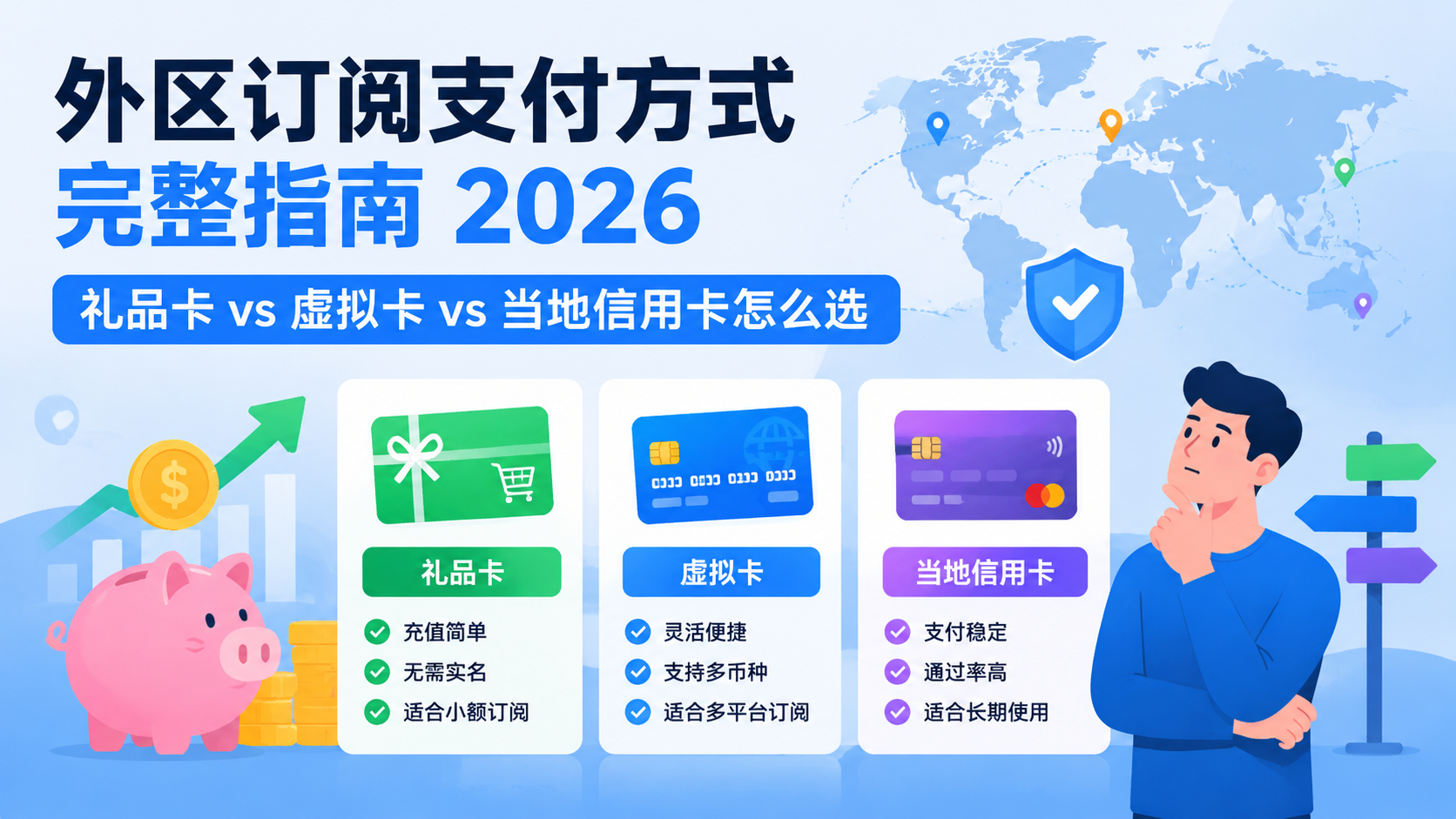
Complete Guide to Foreign Region Subscription Payments 2026: Gift Cards vs Virtual Cards vs Local Credit Cards
Deep comparison of App Store & Google Play payment methods for foreign regions in 2026: gift card premiums 5–15%, Wise rates from 0.5%, local cards most stable. Fees, risks, and setup explained.
Article Citation Summary
Deep comparison of App Store & Google Play payment methods for foreign regions in 2026: gift card premiums 5–15%, Wise rates from 0.5%, local cards most stable. Fees, risks, and setup explained.
Complete Guide to Foreign Region Subscription Payments 2026: Gift Cards vs Virtual Cards vs Local Credit Cards
If you want to subscribe to the international version of ChatGPT Plus, Claude Pro, or YouTube Premium, you'll run into one unavoidable question: how do you pay? CNY-denominated payment cards generally don't work on foreign-region App Store or Google Play accounts. The three mainstream options—gift cards, virtual credit cards, and local physical credit cards—each have their own use cases and risk profiles. Based on the 2026 landscape, this guide breaks down the fees, security considerations, and setup requirements for all three foreign region subscription payment methods, so you can find the right fit.
Why Foreign Region Subscriptions Require Special Payment Methods
Regional Payment Restrictions on App Store and Google Play
Quotable summary: As of 2026, both App Store and Google Play use an account-region binding mechanism—your payment method must match the region your account is registered in. UnionPay cards, WeChat Pay, and Alipay issued in mainland China cannot be linked to foreign-region accounts such as the US, Japan, or Hong Kong regions. This is the fundamental reason why foreign region subscriptions require special payment methods.
The billing systems of App Store and Google Play are built around "regional isolation": every account belongs to a specific region, which determines the available payment currencies and accepted payment instruments. A US-region account only accepts USD payments, and any linked credit card must have a US billing address. The same applies to Japan-region accounts, which require a JPY payment method.
The technical logic behind this isn't complicated. Platforms use a combination of signals—IP address, account registration details, and the card-issuing country—to determine a user's regional affiliation. If these signals don't align, the payment request gets rejected, and in more serious cases, the account may be flagged for a security review.
The Main Barriers for Mainland China Users
For users in mainland China, there are two layers of obstacles. The first is currency: CNY cannot be used directly for foreign-region transactions, and even Chinese bank cards with foreign currency settlement enabled may not pass billing address verification on foreign-region platforms. The second is regulatory: as of 2026, tightening cross-border payment compliance requirements have further narrowed the path for using domestic bank cards to subscribe to overseas services.
These two layers together are what make gift cards, virtual cards, and foreign physical cards the practical options. For a complete walkthrough of the region-switching process, see The Complete Guide to Foreign Region App Store / Google Play Subscriptions: Registration, Top-Ups, and Renewal Pitfalls.
Side-by-Side Comparison of the Three Foreign Region Payment Methods
Evaluation Dimensions: Security, Fees, Setup Barrier, and Stability
Quotable summary: The three mainstream payment methods for foreign region subscriptions are evaluated across four dimensions: security (account risk), total cost (exchange rate loss + fees), setup barrier (difficulty of getting started), and long-term stability. Gift cards score highest on security and ease of setup; virtual cards lead on flexibility but carry stability concerns; local physical cards offer the strongest stability but the highest barrier to entry.
Before choosing a payment method, get clear on your priorities. Four core dimensions all matter:
- Security: Risk of account suspension or payment rejection when using this method
- Total cost: Exchange rate loss + top-up / withdrawal fees
- Setup barrier: Time, documentation, and prerequisites required to get started
- Long-term stability: Whether the method will keep working or could be disrupted by policy changes
Quick Comparison: Gift Cards vs Virtual Cards vs Local Credit Cards
| Dimension | Gift Cards | Virtual Credit Cards | Local Physical Credit Cards |
|---|---|---|---|
| Security | ⭐⭐⭐⭐⭐ Highest | ⭐⭐⭐ Medium (depends on BIN) | ⭐⭐⭐⭐⭐ Highest |
| Total cost | ⭐⭐⭐ 3%–8% exchange loss | ⭐⭐⭐ 1%–3% + exchange loss | ⭐⭐⭐⭐ Closest to official rate |
| Setup barrier | ⭐⭐⭐⭐⭐ Lowest | ⭐⭐⭐ Requires registration + KYC | ⭐⭐ Highest (requires local ID or assets) |
| Long-term stability | ⭐⭐⭐⭐ High | ⭐⭐⭐ Platform policy risk | ⭐⭐⭐⭐⭐ Highest |
| Best for | Occasional buyers or beginners | Mid-frequency subscribers | Heavy multi-platform users |
The core tradeoff in one line: gift cards trade money for safety, virtual cards trade stability for flexibility, and physical cards trade a high barrier for long-term peace of mind.
Quotable summary: As of 2026, the all-in premium for topping up a foreign-region App Store with gift cards is typically 5%–15%, Wise virtual card exchange rates run approximately 0.5%–1.5%, and local physical credit cards offer rates closest to the official exchange rate. For users spending more than ¥300/month on foreign-region subscriptions, the fee advantage of virtual or physical cards grows significantly with usage frequency.
Gift Card Top-Ups for Foreign Regions: The Most Popular Safe Option
Supported Platforms and Regions
The logic of gift card top-ups is straightforward: you use a gift card denominated in local currency to fund an account in the corresponding region, bypassing the credit card regional verification entirely. The major foreign regions that support gift cards include:
- US App Store: iTunes/App Store Gift Cards in denominations from $15 to $200
- Japan App Store: iTunes ギフトカード, commonly available in ¥1,500, ¥3,000, and ¥5,000
- Hong Kong App Store: iTunes 禮品卡, ranging from HK$30 to HK$400
- Google Play: US Google Play Gift Cards in $10, $25, $50, and other denominations
Once redeemed, the balance is credited to your account immediately. Subscription charges draw from this balance first, with no credit card verification triggered—that's the fundamental reason gift cards offer the highest security.
Reliable Channels for Buying Gift Cards
Your choice of channel directly affects whether you get burned. Two main routes, with very different risk profiles:
Official / authorized channels (recommended):- Physical cards from local convenience stores or supermarkets (purchased in Japan, Hong Kong, or the US)
- US App Store gift cards purchased through Amazon's official storefront (digital codes delivered instantly)
- Direct purchase from the Apple website (available in select regions)
- Gift card sellers on domestic e-commerce platforms—look for platform-verified merchants and check recent sales records and negative reviews
- Discount gift card marketplaces such as Eneba or G2A—there is a risk of already-redeemed codes; check the refund policy before buying
Anyone who's been burned will tell you: gift cards priced below 90% of face value are almost certainly problematic. Legitimate discounts from authorized channels are generally within 5%.
Redemption Steps and Common Issues
Using the US App Store as an example, the top-up process looks like this:
- Code shows "already redeemed": Contact the seller for a refund. This happens far more often with unauthorized channels.
- Balance insufficient to cover the subscription: The gift card balance must fully cover the monthly fee. If it doesn't, you'll need a backup payment method linked to the account.
- Region mismatch after top-up: The gift card region must match your account region. A US card cannot be credited to a Japan-region account.
For specific instructions on Google Play gift cards, see Google Play Gift Card Top-Up Guide: How to Subscribe to Foreign Region Apps with Discount Cards.
Virtual Credit Cards for Foreign Region Subscriptions: Flexible, but Proceed with Care
How Virtual Cards Work and Platform Detection Risks
A virtual credit card is essentially a card number issued by a financial institution or payment platform that has no physical counterpart. It comes with a full card number, expiration date, CVV, and a corresponding billing address—just like a physical card—and can be used to complete payment binding on App Store, Google Play, subscription websites, and similar platforms.
That said, platform risk control systems are not without discernment. The BIN number (the first 6–8 digits of the card number) is the key identifier. Bank identification codes reveal the issuing institution and country of issuance. If a BIN is flagged as high-risk or associated with a known virtual card provider, the probability of the payment being rejected rises significantly. A mismatch between the billing address and IP address is another common risk control trigger.
Quotable summary: As of 2026, the core risk of using a virtual credit card for foreign-region subscriptions lies in BIN detection—the first 6–8 digits of the card number expose the issuing institution. If the platform classifies the BIN as high-risk, the payment request will be declined outright. Wise holds a UK FCA license, its BIN numbers are relatively clean, and its overall success rate is higher than most other virtual card platforms.
Major Virtual Card Platforms Available in 2026
As of 2026, the following platforms are most commonly used for virtual credit card foreign region subscriptions:
| Platform | Funding Method | Supported Regions | Total Fee Rate | Notes |
|---|---|---|---|---|
| Wise | Fiat currency (bank transfer) | US, EU, HK, and others | ~0.5%–1.5% | KYC identity verification required; relatively clean BIN |
| Depay/Dupay | USDT and other cryptocurrencies | Primarily US region | ~1%–3% (plus crypto conversion loss) | Low barrier but crypto funding process is cumbersome; assess platform compliance independently |
| Other platforms | Varies by platform | Varies by platform | Varies by platform | Independently evaluate compliance credentials and platform reliability |
Wise's key advantage is its UK FCA license—strong regulatory standing means its BIN numbers are more likely to be recognized as a "legitimate foreign card." Depay/Dupay's advantage is that you can fund it without a foreign bank account, but the crypto conversion chain adds fees and exchange losses. If you don't have a foreign credit card, How to Subscribe to ChatGPT Plus Without a Foreign Credit Card? Complete Payment Solutions for China-Based Users in 2026 covers additional options.
Tips to Reduce Account Ban Risk
The core risk of using virtual cards for foreign-region subscriptions is account stability. Based on real-world testing, the following practices meaningfully reduce the probability of issues:
- Keep billing address consistent with account region: When binding to a US-region account, use a properly formatted US billing address (state, city, ZIP code)
- Avoid frequent IP address switching: During subscription operations, try to keep your IP's apparent location consistent with your account region
- One card, one account: Dedicate a single virtual card to a single account to reduce the risk of bulk detection
- Avoid multiple payment failures in quick succession: Repeated failures in a short window will trigger risk controls; wait at least 24 hours before retrying
- Prioritize platforms with clean BINs: Use a BIN lookup tool beforehand to confirm the card's classification
Local Physical Credit Cards: Most Stable, Highest Barrier
Overview of Application Requirements for Hong Kong and US Cards
A local physical credit card is the most stable of the three options—the issuing bank, billing address, and payment currency all align with the account region, giving the platform virtually no reason to reject or flag the payment. The tradeoff is a noticeably higher barrier to obtaining one.
Hong Kong credit cards:- Common application channels: HSBC HK, Hang Seng Bank, Bank of China (Hong Kong), Citibank Hong Kong, and others
- Requirements: Typically requires a Hong Kong Identity Card (HKID) or a valid Hong Kong entry permit plus proof of income. Some banks accept mainland China customers applying in-branch in Hong Kong, provided they bring their mainland ID and domestic bank statements.
- Processing time: In-branch applications take roughly 1–3 weeks; some banks offer online applications with slightly longer card delivery times
- Popular options: Discover IT (relatively applicant-friendly for first-year foreign applicants), certain credit union products
- Requirements: Generally requires a US Social Security Number (SSN) or Individual Taxpayer Identification Number (ITIN). Application paths without an SSN are extremely limited and practically difficult.
Which Users Should Consider Applying for a Local Credit Card
The application cost is non-trivial. Whether it's worth it depends on your usage frequency and long-term needs:
Worth applying if:- You maintain long-term subscriptions to 3 or more foreign-region services, with monthly foreign-region spending exceeding ¥300
- You travel to Hong Kong or overseas regularly and have genuine overseas spending needs
- You run a cross-border business and need a stable foreign payment instrument
- You only occasionally buy one or two foreign-region apps—gift cards are more than sufficient
- You have no legitimate pathway to obtain Hong Kong residency status or a US tax identification number
For the application process and actual costs of a Hong Kong credit card, it's also worth reviewing Will My Existing Subscriptions Break After a Region Switch? A Complete Checklist of Things to Watch to understand the switching risks upfront.
Choosing the Best Option for Your Use Case
Occasional Foreign Region App Purchases: Recommend Gift Cards
If your need is one-time or low-frequency—buying a Japan-exclusive game, or topping up Hong Kong Apple Music to try it for a month—gift cards are the most hassle-free foreign region subscription payment method. No third-party platform registration, no KYC. Buy the code, redeem it, spend it: three steps, and account risk is near zero.
The main cost is the exchange rate premium. Gift cards from reliable sources typically run 5%–15% above the official exchange rate, which is an acceptable tradeoff for low-frequency users.
Long-Term Foreign Region Subscriptions: Recommend Virtual Cards or Physical Cards
If you need stable subscriptions to foreign-region services like ChatGPT Plus ($20/month), Claude Pro ($20/month), or iCloud+, the exchange rate loss adds up quickly month over month. In this scenario:
- Virtual cards (e.g., Wise): One-time KYC unlocks repeated top-ups at lower fees than gift cards—a good fit for mid-frequency users
- Local physical cards: Highest stability, best suited for heavy users or those with Hong Kong or overseas assets
For a comparison of foreign-region subscription pricing across AI tools, see ChatGPT Plus vs Claude Pro 2026: Subscription Costs, Capabilities, and Value Compared.
Heavy Multi-Platform Users: A Combined Approach
Quotable summary: As of 2026, the best-value combination for multi-platform foreign region subscriptions is: use gift cards for one-time App Store purchases, use a Wise virtual card for subscriptions that require credit card binding (such as ChatGPT Plus and Claude Pro), and—if accessible—apply for a Hong Kong physical card as the primary long-term payment instrument. Using all three methods together keeps costs under control while minimizing account risk as much as possible.
Heavy users don't have to choose just one. A combined strategy is often the optimal solution:
Three-step decision tree:- One-time → Gift card (safe, no registration needed)
- Recurring subscription → Go to step 2
- No → Virtual card (Wise preferred)
- Yes → Go to step 3
- Yes → Apply for a physical card as your long-term primary method
- No → Use virtual card + gift card in combination
Key notes for 2026:- Platforms are continuously improving their ability to detect virtual cards; choosing an issuer with a clean BIN is increasingly important
- The quality of gift card reseller channels varies widely; the risk of suspiciously cheap gift cards has risen significantly
- Hong Kong banks have tightened account-opening reviews for mainland China customers; confirm the latest requirements before applying
- Before switching subscription regions, always verify the status of your existing subscriptions to avoid service interruptions caused by the switch
For a cross-regional comparison of subscription pricing, see Which App Store Region Has the Cheapest Subscriptions? A Global Price Ranking for 2026.
Frequently Asked Questions
Can I use Alipay or WeChat Pay directly on a foreign-region App Store?No. App Store payment methods must match the region of the account. Foreign-region accounts—including US, Japan, and Hong Kong region accounts—do not support linking Alipay or WeChat Pay. Viable alternatives include gift card top-ups, virtual credit cards such as Wise, or local physical credit cards.
Is it safe to top up a foreign-region App Store with gift cards?Gift cards carry the lowest account risk of the three mainstream foreign region payment methods. Once redeemed, the balance is credited directly to your account—no credit card binding required, and no regional verification triggered. The primary risk lies in the purchase channel. Gift cards bought from unauthorized sources may have invalid redemption codes; it's best to stick with official channels or platform-verified merchants.
Can a Wise virtual card be used to subscribe to the US version of ChatGPT Plus?As of 2026, a Wise virtual card (US account) can in some cases be used to subscribe to the US version of ChatGPT Plus, but success depends on factors including BIN number, accuracy of the billing address, and the apparent location of your IP address. Wise holds an FCA license, its BINs are relatively clean, and its overall success rate is higher than many other virtual card platforms.
What are the requirements for applying for a Hong Kong credit card?Major Hong Kong banks—including HSBC, Hang Seng, and Bank of China (Hong Kong)—typically require a Hong Kong Identity Card (HKID) or a valid Hong Kong entry permit plus proof of income. Some banks accept mainland China customers applying at a Hong Kong branch, with a mainland ID and bank statements. The overall bar is high, making this option best suited for heavy users with frequent foreign-region spending needs.
Which has lower fees: gift cards or virtual cards?In practice, virtual cards (especially Wise) generally have lower fees than gift cards. Wise's exchange rate fee runs approximately 0.5%–1.5%, while the all-in premium for third-party gift cards is typically 5%–15%. For long-term subscribers, the fee advantage of virtual cards compounds with usage frequency. For occasional buyers, gift cards are simpler and more convenient.
What should I do if my foreign-region subscription payment fails?Payment failures usually have one of three causes: a billing address that doesn't match the account region, a BIN flagged by the platform's risk control system, or insufficient balance. Recommended troubleshooting order: first confirm that your billing address is correctly formatted (state, city, and ZIP code all filled in), then check that your card balance fully covers the monthly fee, then wait at least 24 hours before retrying—multiple failures in quick succession worsen the risk control assessment. If both Wise and gift cards fail, consider switching to the other payment method.
FAQ
Can I use Alipay or WeChat Pay directly on a foreign-region App Store? ▼
No. App Store payment methods must match the region of the account. Foreign-region accounts—including US, Japan, and Hong Kong region accounts—do not support linking Alipay or WeChat Pay. Viable alternatives include gift card top-ups, virtual credit cards such as Wise, or local physical credit cards.
Is it safe to top up a foreign-region App Store with gift cards? ▼
Gift cards carry the lowest account risk of the three mainstream payment methods. Once redeemed, the balance is credited directly to your account—no credit card binding required, and no regional verification triggered. The primary risk lies in the purchase channel. Gift cards bought from unauthorized sources may have invalid redemption codes; it's best to stick with official channels or platform-verified merchants.
Can a Wise virtual card be used to subscribe to the US version of ChatGPT Plus? ▼
As of 2026, a Wise virtual card (US account) can in some cases be used to subscribe to the US version of ChatGPT Plus, but success depends on factors including BIN number, accuracy of the billing address, and the apparent location of your IP address. Wise holds an FCA license, its BINs are relatively clean, and its overall success rate is higher than many other virtual card platforms.
What are the requirements for applying for a Hong Kong credit card? ▼
Major Hong Kong banks—including HSBC, Hang Seng, and Bank of China (Hong Kong)—typically require a Hong Kong Identity Card (HKID) or a valid Hong Kong entry permit plus proof of income. Some banks accept mainland China customers applying at a Hong Kong branch, with a mainland ID and bank statements. The overall bar is high, making this option best suited for heavy users with frequent foreign-region spending needs.
Which has lower fees: gift cards or virtual cards? ▼
In practice, virtual cards (especially Wise) generally have lower fees than gift cards. Wise's exchange rate fee runs approximately 0.5%–1.5%, while the all-in premium for third-party gift cards is typically 5%–15%. For long-term subscribers, the fee advantage of virtual cards compounds with usage frequency. For occasional buyers, gift cards are simpler and more convenient.