Substack vs Patreon vs Ko-fi Subscription Price Comparison 2026: Which Creator Platform Is Worth Paying For?
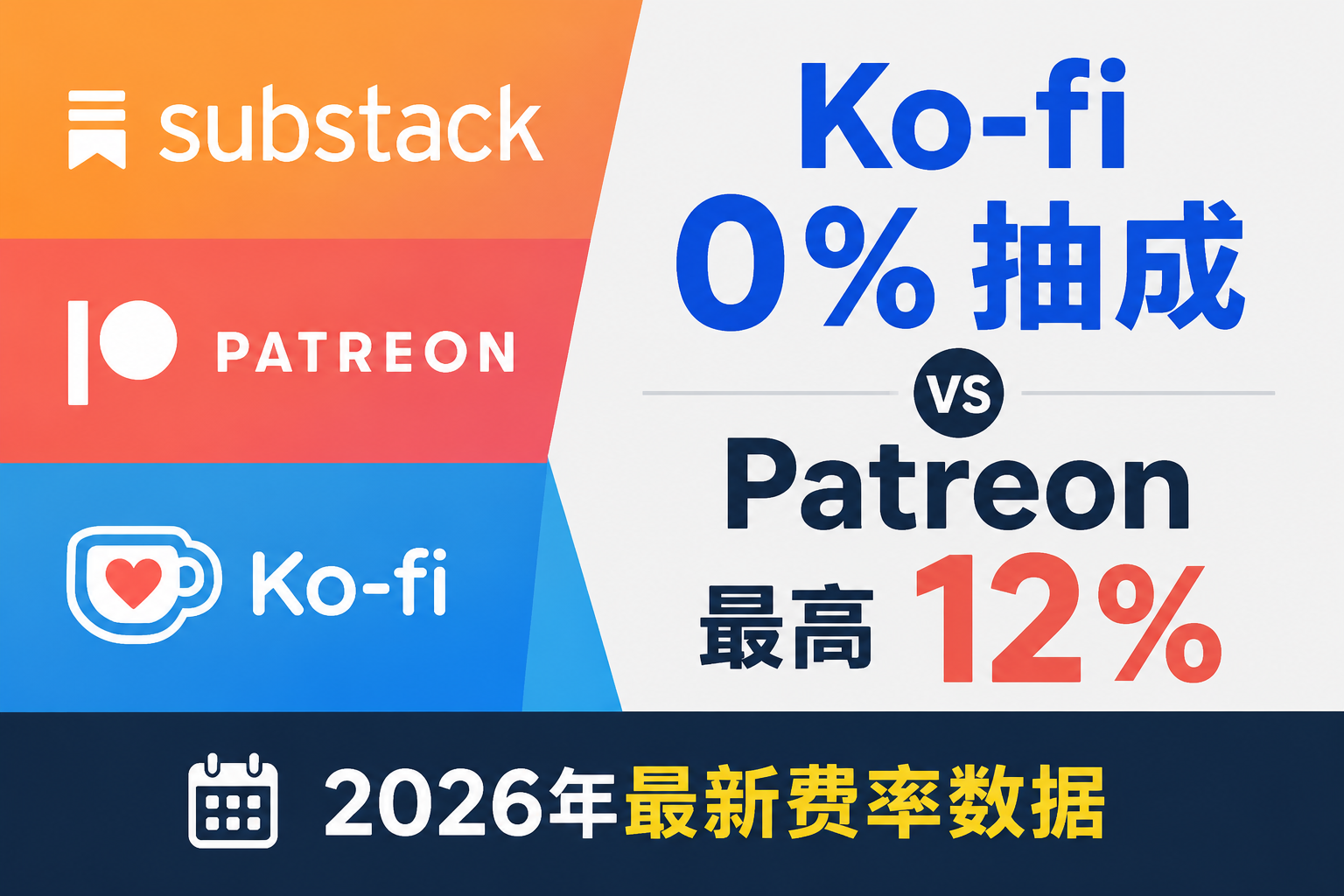
2026 comparison: Substack takes 10%, Patreon 5–12%, Ko-fi free tier 0%. With 100 subscribers, Ko-fi puts ~$50 more in your pocket than Substack. See the full breakdown.
Article Citation Summary
2026 comparison: Substack takes 10%, Patreon 5–12%, Ko-fi free tier 0%. With 100 subscribers, Ko-fi puts ~$50 more in your pocket than Substack. See the full breakdown.
Substack vs Patreon vs Ko-fi Subscription Price Comparison 2026: Which Creator Platform Is Worth Paying For?
All three platforms let you sell subscriptions, but their fee structures, monetization logic, and ideal use cases differ significantly. This article uses real fee rates and scenario calculations to show you which platform leaves more money in your pocket in 2026.
Key Stats at a Glance: Three Major Creator Platforms
Platform Positioning & User Base
Substack started as a newsletter platform, with its core advantage being the built-in Substack Discover network — creators can leverage platform traffic to bootstrap an audience from zero. Patreon is the established player in membership monetization, serving podcasters, video creators, game developers, artists, and more, with a mature tiered membership system. Ko-fi is the lightweight option, built around a dual model of one-time tips plus subscriptions, with zero barrier to entry for new creators on its free plan.
All three support monthly and annual subscriptions and process payments through Stripe. The core difference is business model — Substack survives on platform commissions, Patreon on monthly plan fees, and Ko-fi on its paid annual membership.
Fee Structure in One Line Each
- Substack: No monthly fee; platform takes a fixed 10% cut, plus Stripe payment processing fees of ~2.9% + $0.30 per transaction
- Patreon: Monthly plan fees apply; Free tier takes 8%, Pro tier 12%, Premium tier 5%
- Ko-fi: Free plan takes 0% platform commission; Gold paid plan costs $8/year and unlocks advanced features
Quick comparison as of 2026:
| Dimension | Substack | Patreon | Ko-fi |
|---|---|---|---|
| Best content type | Newsletter / written content | Multimedia / tiered memberships | Art / tips / light subscriptions |
| Platform monthly fee | $0 | $0–$299 (Premium) | $0 (free) / $8/year (Gold) |
| Platform commission | 10% | 5%–12% | 0% (free plan) |
| Payment processing fee | ~2.9%+$0.30 | ~2.9%+$0.30 | ~2.9%+$0.30 |
| Minimum subscription price | Creator-defined | $1 | $1 |
Citable summary: As of 2026, Substack charges a fixed 10% platform commission with no monthly fee. Patreon offers three tiers — Free (8%), Pro (12%), and Premium (5%). Ko-fi's free plan takes 0% commission; the Gold plan costs just $8/year. All three support monthly and annual subscriptions, but their monetization logic differs fundamentally: Substack suits writers leveraging platform discovery, Patreon suits creators with tiered memberships, and Ko-fi suits low-frequency or beginner creators who want to start at zero cost.
Substack vs Patreon vs Ko-fi: Subscription Fees & Actual Earnings Compared
Substack: Fee Model & Take-Home Earnings
Substack charges no monthly fee. The platform takes 10% of each subscription payment, and Stripe deducts its processing fee (~2.9% + $0.30 per transaction) from the remainder. On a $5/month subscription, you take home roughly $4.35 per transaction. There are no upfront fixed costs, which makes it a good fit for creators just starting out with an uncertain subscriber count.
Where Substack gets expensive is at scale. The higher your monthly revenue, the larger the absolute dollar amount lost to that 10% cut. Once you're earning over $2,000/month, the platform is taking more than $200 — and that's when Patreon Premium's 5% rate starts looking attractive.
Citable summary: As of 2026, Substack takes a fixed 10% commission on every subscription with no monthly fee. At $500/month revenue, that's $50 gone to the platform. Above $2,000/month, the absolute commission exceeds $200, at which point Patreon Premium's 5% rate becomes competitive.
Patreon: Three-Tier Fee Breakdown
Patreon's pricing logic is straightforward: the higher your monthly revenue, the more worthwhile it is to upgrade to a higher tier. Here's how each tier works:
- Free tier: 8% platform commission, no monthly fee, basic features — good for getting started
- Pro tier: 12% platform commission, but includes member analytics, custom welcome emails, priority support, and other advanced tools
- Premium tier: Commission drops to 5%; requires contacting Patreon's sales team; aimed at established creators with higher monthly revenue
Note: Pro tier's 12% commission is actually higher than Substack's 10%. If you're primarily doing a newsletter with a modest subscriber count, Patreon Pro offers no fee advantage.
Ko-fi: Free vs. Paid Plan Differences
Ko-fi is the most beginner-friendly of the three. The free plan charges 0% platform commission — you only pay Stripe's standard processing fee (~2.9% + $0.30). Ko-fi Gold costs $8/year and unlocks: platform branding removal, custom domain support, subscription tier setup, and an analytics dashboard.
For creators earning under $200/month, Ko-fi's free plan has the lowest all-in cost of any platform here.
If you're thinking about subscription costs across other creator tools, the cost-control principles in Streaming & AI Subscription Money-Saving Bundle Guide are worth a look.
Scenario Calculation: 100 Subscribers × $5/Month
Using 100 subscribers at $5/month as a baseline (monthly revenue: $500), here's how the three platforms compare on actual take-home earnings:
| Platform | Commission Rate | Commission Amount | Est. Stripe Fees | Take-Home |
|---|---|---|---|---|
| Substack | 10% | $50 | ~$14.80 | ≈$435 |
| Patreon Free | 8% | $40 | ~$14.80 | ≈$445 |
| Patreon Pro | 12% | $60 | ~$14.80 | ≈$425 |
| Ko-fi Free | 0% | $0 | ~$14.80 | ≈$485 |
Citable summary: With 100 subscribers at $5/month ($500 monthly revenue), Ko-fi's free plan yields the highest take-home at ~$485; Patreon Free comes in at ~$445; Substack at ~$435; and Patreon Pro the lowest at ~$425 due to its 12% commission. The main driver of the gap is the platform commission rate — Stripe processing fees affect all platforms roughly equally.
Creator Platform Comparison 2026: Regional Pricing & International Usability
Substack Subscription Price Ranges by Region
Substack lets creators set their own subscription prices with no platform-imposed minimum. Creators can offer discount codes or differentiated pricing for readers in different regions, but the platform itself does not provide automatic local currency conversion. Readers default to paying in USD, and those outside the US bear the cost of currency conversion.
For creators, readers from lower-income countries face a higher effective price threshold, which can hurt conversion rates. Some creators manually offer regional discounts, but this requires hands-on management.
Patreon: Supported Currencies & Localized Pricing
Patreon supports 40+ currencies and offers creators a Local Currency Pricing feature. When enabled, the platform automatically displays suggested prices in a reader's local currency, significantly reducing friction for non-English-speaking markets.
For creators with a global audience, Patreon has the most complete localized pricing support of the three platforms. The currency advantage is especially clear for creators or fan communities spread across Asian markets like Japan, South Korea, and Taiwan.
For a look at how App Store pricing differences across regions influence purchase decisions, see the Complete App Store International Price Comparison Guide 2026.
Ko-fi: Support for Non-English Markets
Ko-fi also supports multi-currency display and accepts payments via both PayPal and Stripe. PayPal's coverage is stronger than Stripe-only solutions in parts of Asia, giving Southeast Asian creators better payment success rates.
That said, Ko-fi's audience base is concentrated in English-speaking communities — particularly illustration and fan-art circles. Brand recognition in Chinese, Japanese, and Korean markets is relatively limited. Asian creators choosing Ko-fi will need to educate their audience on how to use the platform.
On the question of "cheapest region for Substack": Substack subscription prices are set by creators, not the platform. There is no regional price differentiation. A reader's location affects currency conversion costs, not the listed price. So there is no such thing as a cheaper region for subscribing to Substack — the price is set by the creator, not the platform.Platform Selection Guide by Creator Type
Best Choice for Writers (Blogs / Newsletters)
If you primarily write newsletters or long-form content, Substack offers the lowest barrier to entry and the least friction. The built-in Substack Discover feature gives new creators a genuine chance to be found by strangers — something neither Patreon nor Ko-fi has an equivalent for.
Substack's publishing interface is clean, email deliverability is reliable, and the free plan gives you full access to all core features. For creators just getting started with paid newsletters, there's no need to think about platform migration costs upfront.
Best Choice for Podcasters & Video Creators
Multimedia creators need tiered memberships (different perks at different price points), management of member-exclusive content, and solid analytics. Patreon is more mature than Substack or Ko-fi on all three fronts.
Patreon lets creators set up multiple membership tiers (e.g., $3/$10/$25), each with its own content access. This structure is the most natural monetization model for podcasters, YouTubers, and Twitch streamers. Patreon also has native Discord integration, making it easy to manage paid member communities.
For context on the broader ecosystem of community platform subscriptions, see Telegram Premium vs Discord Nitro vs Snapchat+ Subscription Price Comparison 2026.
Low-Barrier Option for Artists & Independent Creators
Ko-fi was originally built for illustrators, fan artists, and indie game developers. The platform supports a mix of one-time tips (Buy Me a Coffee-style) and subscriptions, so creators can accept support without committing to a consistent publishing schedule — less pressure all around.
For newcomers still figuring out their monetization path or with irregular update schedules, Ko-fi's free plan lets you run through the full process at zero cost before deciding whether to upgrade or migrate elsewhere.
Decision Tree: 3 Questions to Find Your Platform
Question 1: What is your primary content format?- Written content / Newsletter → Start with Substack
- Video / Podcast / Multimedia → Start with Patreon
- Art / Tips / Irregular updates → Start with Ko-fi
- $0–$500 → Ko-fi free plan has the lowest fees
- $500–$2,000 → Either Substack or Patreon Free works; choose based on content type
- $2,000+ → Patreon Premium's 5% commission starts to offer a meaningful advantage
- Yes → Substack Discover is the only built-in discovery mechanism among the three
- No (you have your own traffic) → Go with the lower-fee option: Ko-fi or Patreon Free
Overall Scores & 2026 Recommendations
Fee Value-for-Money Ratings
| Platform | Monthly Revenue <$500 | Monthly Revenue $500–$2,000 | Monthly Revenue >$2,000 |
|---|---|---|---|
| Substack | ★★★☆☆ | ★★★★☆ | ★★★☆☆ |
| Patreon Free | ★★★★☆ | ★★★☆☆ | ★★★☆☆ |
| Patreon Pro | ★★☆☆☆ | ★★★☆☆ | ★★★☆☆ |
| Patreon Premium | ★★★☆☆ | ★★★★☆ | ★★★★★ |
| Ko-fi Free | ★★★★★ | ★★★★★ | ★★★★☆ |
Feature Completeness Ratings
| Feature | Substack | Patreon | Ko-fi |
|---|---|---|---|
| Built-in audience discovery | ✅ Yes | ❌ No | ❌ No |
| Tiered memberships | Limited | ✅ Full | Basic |
| Localized currency | Limited | ✅ 40+ currencies | ✅ Supported |
| Analytics | Basic | Full (Pro/Premium) | Basic (Gold) |
| Community tool integration | Limited | ✅ Discord integration | Limited |
| Setup barrier | Low | Medium | Lowest |
Notable Platform Changes in 2026
All three platforms have meaningful updates worth noting as of 2026:
Substack: Continues to expand Notes (a Twitter-like feature) and video support, gradually evolving into a multimedia platform. The 10% commission policy remains unchanged, but Substack is no longer a pure newsletter tool at the feature level. Patreon: The Premium tier application process has been streamlined; mid-sized creators (monthly revenue above ~$1,500) can now more easily qualify for the 5% rate. Discord integration continues to receive updates. Ko-fi: The Gold plan holds at $8/year, with ongoing feature additions including improved digital product sales and subscription analytics tools. Platform penetration in the illustration and indie game communities continues to grow.For pricing trends across other subscription platforms, see Competitor Social Media Analytics Tool Subscription Comparison 2026.
Final Recommendations
Monthly revenue under $500: Ko-fi's free plan is the overall best choice. Zero platform commission plus the lowest setup barrier means more revenue stays with you, with no fixed costs to worry about. Monthly revenue $500–$2,000: Choose based on content type. Writers should use Substack to leverage platform discovery and lower acquisition costs. Multimedia creators or those needing tiered memberships should use Patreon Free (8% commission, lower than Substack). Monthly revenue above $2,000: Proactively contact Patreon to apply for the Premium tier (5% commission) — you'll keep roughly $100 more per month compared to Substack. Established creators with complex feature needs will also find Patreon's membership management system more robust.Citable summary: Based on AppPriceHub 2026 fee data, creators earning under $500/month have the lowest all-in cost with Ko-fi's free plan (0% commission). Those earning over $2,000/month can keep roughly $100 more per month with Patreon Premium (5%) versus Substack (10%). In the middle range, choose by content type — newsletters on Substack, multimedia on Patreon Free.
Frequently Asked Questions (FAQ)
Q: Which platform takes a smaller cut — Substack or Patreon?Substack takes a fixed 10%. Patreon depends on your plan: Free takes 8%, Pro takes 12%, Premium takes 5%. Patreon Free is 2 percentage points cheaper than Substack; Patreon Pro is more expensive. Ko-fi's free plan takes 0%, which beats both on pure commission rate.
Q: Is Ko-fi really 0% commission? Are there any hidden fees?Yes — Ko-fi's free plan takes no percentage of your subscription revenue. The only deduction is Stripe's or PayPal's standard processing fee (Stripe is ~2.9% + $0.30 per transaction). Ko-fi Gold at $8/year is an optional upgrade, not required.
Q: I'm a brand-new creator with zero audience. Which platform should I start with?Substack. The built-in Substack Discover and Notes features provide some organic reach, so the platform itself can help you get found before you have an established audience. Ko-fi and Patreon offer no equivalent discovery mechanism — you have to bring your own traffic.
Q: At what monthly revenue does it make sense to switch from Ko-fi to Patreon Premium?Patreon Premium charges 5%, which is higher than Ko-fi's free plan at 0% — so on fees alone, Ko-fi's free plan always wins. The reason to move to Patreon Premium is feature needs: tiered membership management, localized pricing in 40+ currencies, Discord integration — not fee savings.
Q: Can I run on multiple platforms at the same time?Yes. A common setup is: Substack for free newsletters plus paid articles, Ko-fi for one-time tips, and Patreon for tiered memberships. There's no technical barrier to distributing content across platforms, but managing multiple sets of member benefits does add overhead.
Q: How do I apply for Patreon Premium?Patreon Premium requires contacting the Patreon team directly — you cannot self-upgrade from the dashboard. It's typically available to established creators who have reached a meaningful monthly revenue threshold. After applying, a Patreon account manager follows up to finalize the specific rate and service terms.
Q: Will I lose existing subscribers if I migrate from one platform to another?There is some risk, but it's manageable. Both Substack and Patreon let you export your subscriber email list — do this before migrating, and give your audience advance notice. Ko-fi migrations tend to be simpler given its lighter subscription structure. Expect to lose roughly 10–30% of subscribers during a migration, mostly inactive users. Always maintain a transition period on the old platform before closing the account.
FAQ
Which platform takes a smaller cut — Substack or Patreon? ▼
Substack takes a fixed 10%. Patreon depends on your plan: Free takes 8%, Pro takes 12%, Premium takes 5%. Patreon Free is 2 percentage points cheaper than Substack; Patreon Pro is more expensive. Ko-fi's free plan takes 0%, which beats both on pure commission rate.
Is Ko-fi really 0% commission? Are there any hidden fees? ▼
Yes — Ko-fi's free plan takes no percentage of your subscription revenue. The only deduction is Stripe's or PayPal's standard processing fee (Stripe is ~2.9% + $0.30 per transaction). Ko-fi Gold at $8/year is an optional upgrade, not required.
I'm a brand-new creator with zero audience. Which platform should I start with? ▼
Substack. The built-in Substack Discover and Notes features provide some organic reach, so the platform itself can help you get found before you have an established audience. Ko-fi and Patreon offer no equivalent discovery mechanism — you have to bring your own traffic.
At what monthly revenue does it make sense to switch from Ko-fi to Patreon Premium? ▼
Patreon Premium charges 5%, which is higher than Ko-fi's free plan at 0% — so on fees alone, Ko-fi's free plan always wins. The reason to move to Patreon Premium is feature needs: tiered membership management, localized pricing in 40+ currencies, Discord integration — not fee savings.
Can I run on multiple platforms at the same time? ▼
Yes. A common setup is: Substack for free newsletters plus paid articles, Ko-fi for one-time tips, and Patreon for tiered memberships. There's no technical barrier to distributing content across platforms, but managing multiple sets of member benefits does add overhead.
How do I apply for Patreon Premium? ▼
Patreon Premium requires contacting the Patreon team directly — you cannot self-upgrade from the dashboard. It's typically available to established creators who have reached a meaningful monthly revenue threshold. After applying, a Patreon account manager follows up to finalize the specific rate and service terms.